Joe Rantz makes Washington’s first freshman boat
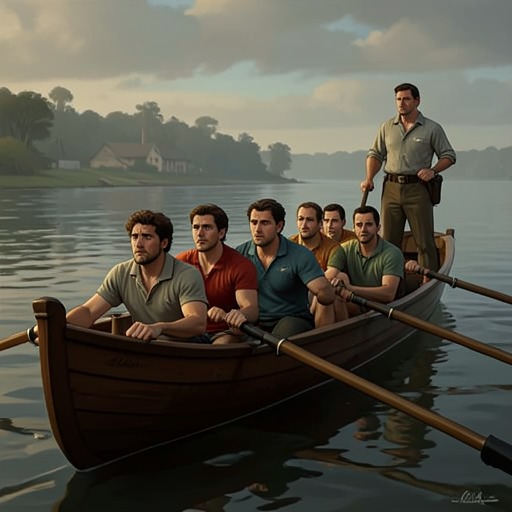
The Boys in the BoatThe announcement that Joe Rantz had made the first freshman boat marked his first concrete advancement in the Washington Huskies rowing team: on November 28, Coach Tom Bolles named him to number three, with Roger Morris in the bow. The selection changed the boys’ immediate prospects, but Bolles stressed that it was preliminary. A place on the boat opened a contest for the seats, not a promise that the contest was over.
The stakes of collegiate crew
In the 1920s and 1930s, collegiate crew could command audiences and press attention on a scale comparable to baseball and college football. Major regattas drew national sportswriters, and fans followed crews through their training and racing seasons. In the East, rowing was also bound up with elite institutions: private schools modeled on Eton College prepared young men for universities such as Harvard University, Yale University, and Princeton University. A selection for a university boat therefore placed a freshman within a sport with both public stature and a long-established social tradition.
The western programs had their own growing audience. The rivalry between the University of California, Berkeley and the University of Washington, dating from 1903, brought tens of thousands of students, alumni, and local spectators to their annual April races. Yet western crews had long struggled for recognition and resources. Their coaches received a fraction of eastern coaches’ pay, they had no recruiting funds, and they usually raced one another rather than the eastern colleges that dominated national attention. That imbalance made success at Washington more than a matter of individual seat assignments: each new crew represented the program’s effort to establish itself against an eastern center of rowing power.
The history of the Intercollegiate Rowing Association regatta at Poughkeepsie sharpened that contrast. Eastern colleges dominated its early years; when Washington first entered in 1913 under Hiram Conibear, the team finished third, startling eastern spectators and the press. Washington’s narrow 1923 victory over Navy later gave the West its first IRA win, but it did not erase the broader disparity in prestige and resources. The freshman selection took place within a program whose ambitions were real, but whose standing had been hard won.
The announcement in the shell house
The freshmen’s final workout of the fall term was cold. After the boys returned to the shell house, Bolles told them to stay while he went into Al Ulbrickson’s office. Through the steamy glass panes, the rowers could see the two coaches bent over a desk and studying a sheet of paper. The detail turns selection into a visible, suspended decision: the list was already there, but the boys outside the office did not yet know what it contained.
The room’s ordinary post-practice noise ebbed. The shell house smelled of sweat, damp socks, and mildew; weak late-afternoon light came through the high windows, and gusts struck the large sliding door. As the coaches remained inside, the boys’ banter gave way to silence. In the loft, George Pocock tapped as he worked on the frame of a new shell. Roger drifted to stand beside Joe, toweling his hair. The coaches’ quiet deliberation, the unfinished boat overhead, and the waiting rowers shared the same space, while the paper held the immediate answer to who would row where.
Bolles came out carrying the list, climbed onto a bench, and faced the boys gathered in a semicircle. Before reading the names, he called the choices preliminary. Everyone could continue competing for a seat, he said, and nobody should become conceited or assume that selection made him secure. The warning established the meaning of the announcement before the names were read: recognition mattered, but no one had yet earned immunity from further competition.
Joe and Roger make the first boat
Bolles read the second-boat assignments first. Joe glanced at Roger, whose gaze had settled morosely on the floor; neither boy’s name had been called. The delay made their uncertainty concrete, but only briefly. When Bolles began the first-boat assignments, he named Roger for the bow seat and Joe for number three. Their names placed both beside the presumptive favorites, rather than among the primary challengers assigned to the second boat.
Joe’s response was deliberately small. He clenched his fist at his side and gave it a restrained pump, taking care not to celebrate openly in front of boys who had not been selected. Roger, standing next to him, softly exhaled. The two gestures registered different forms of release: Joe contained the pleasure of being chosen, while Roger let go of the tension that had kept him looking down. Neither reaction turned the preliminary list into a final verdict, but both showed what the announcement had meant to the boys waiting for it.
The first row after selection
As the unselected boys headed for the showers, those named to the first boat took a shell barge from its rack, lifted it overhead, and carried it down to the lake. Their first response to the news was collective work: before rowing, they had to move the shell together. They then went out into a light, cutting wind, but chose a route toward calmer water rather than the open reach of Lake Washington. At sunset, they rowed west through the Cut and Portage Bay and onto Lake Union.
The air had fallen into the upper thirties, yet Joe hardly noticed the cold. As the shell moved onto Lake Union, city traffic receded, leaving the coxswain’s rhythmic calls amid the silence. Joe’s seat traveled smoothly on its greased runners; his arms and legs moved in a motion that felt almost easy, and his blade entered the dark water with only a murmur. The scene does not certify that his place is permanent. Instead, it follows the announcement with the physical work it makes possible: Joe is no longer only waiting to learn whether he belongs in the first boat; he is rowing in it, alongside the other selected freshmen, while the competition for its seats remains open.